Glenn E. Welch grew up in Michigan and moved to South Bend in 1900 (at age 17) for no known reason but perhaps because the economy was booming here. He was a railroad clerk when he married his wife, Agda Blomquist, in 1909. They lived on the west side of the city, near the Studebaker headquarters where he worked. Welch started as a traffic clerk at Studebaker and rose through the ranks to an executive position. Studebaker was a huge, sprawling enterprise during those years and the time corresponded with the Great Migration of African Americans from the south to work in the plant, among others. Their house on Blaine Ave. was close to the plant. So was the housing for African American workers. Now, the house is in a deteriorating part of town and the home itself is condemned.
Those may be coincidences that were meaningless to the Welches. But starting in the mid 1920s, investors had formed the Coquillard Land Company, which purchased more than 80 acres of forest north of the then-city border, McKinley Ave. Their advertising in the South Bend Tribune shows that the Coquillard Land Company’s mission was not just to make money, but to ensure that the hundreds of new homes they were building would be inhabited by the “right people”. The city appeared to be working to divide itself into turfs; us and them, black and white, richer and poorer.
One of the early houses the Coquillard Land Company advertised is the home across the street from us, which was built in 1930 at the height of the Great Depression. The advertisements demonstrate that they were unable to sell the home and were offering it to rent at $70 per month noting “We want it occupied by the right kind of folks!” The house pictured looks almost exactly the same as it does today: a light-colored bungalow and separate garage. The original ad showed a pergola connecting the garage and the back door of the house. That is gone, replaced by an additional room.
The Welches bought two plots of land in Coquillard Woods and built their own house (now ours) on the corner lot. Later, they built a house on the other plot for their daughter and son-in-law.
Glenn and Agda’s house was finished in 1937. According to census records, the house was worth $10,000 in 1940, or about $188,000 in today’s dollars only a few years after the worst of the Depression. He lists his income at $4,000 a year, or about $75,000 in today’s dollars. By comparison, the salesman who rented the house my neighbor owns now rented it for $47 a month and earned $2,400 a year, or $884 and $45,000 in today’s dollars.
Welch was an avid golfer at the new course nearby. He was either quite enamored with or worked on the short-lived production of the “Rockne” car from 1931-32 (or both). All of the door plates in the house are an image of the “Rockne” hood ornament. (The “Rockne” was, in part, a victim of The Great Depression.)
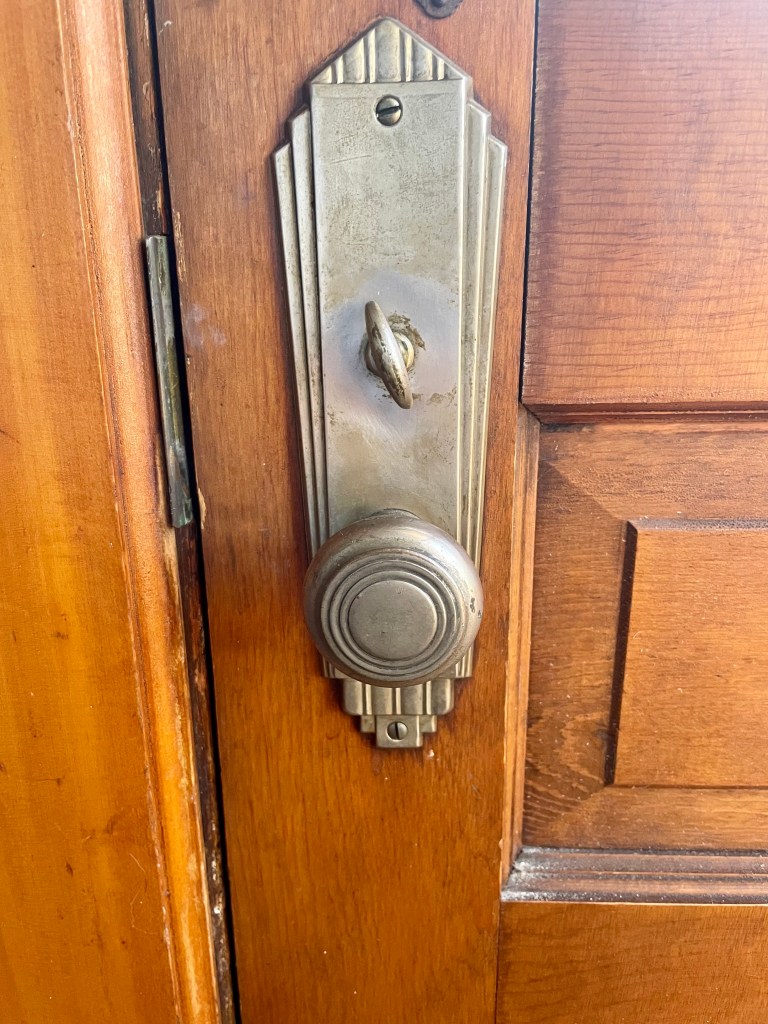
This door is one of two back doors. We have no idea why they installed two back doors–one going into a mudroom that connected to a powder room and small bedroom, all of which was closed off by another door to the kitchen. Those rooms could have been built as a “maid’s chamber” which would have been common at the time. Potentially, the second back door was used by the homeowners. However, census records show that no one lived here while the Welches did other than Glenn and Agda. In our renovation, this door is going away, along with the dead-space hallway connecting to it) to expand the kitchen. We want to respect the history, not be a slave to it!
News articles from the 1930s through the 1950s suggest that the Welches entertained quite a bit in the house, which could explain why they wanted a reasonably open floor plan especially between the large dining room and living room.
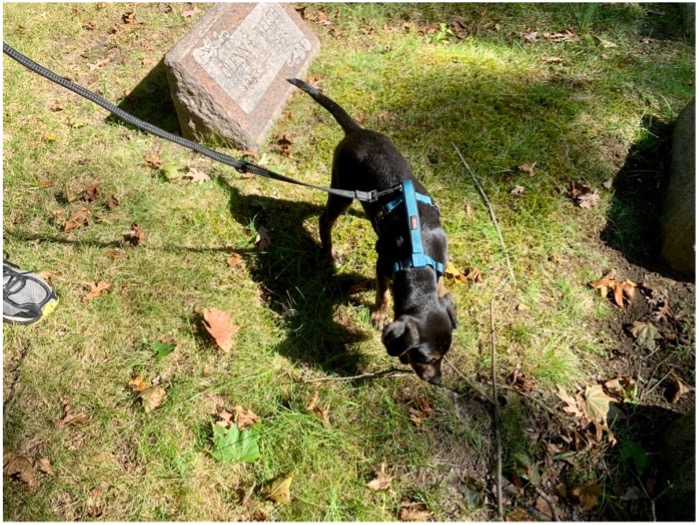
Glenn and Agda lived here until he died in 1957. Agda moved with her daughter and son-in-law shortly thereafter to southern California. We went in search of his grave at the start of the Covid pandemic to honor him and to give our then-new puppy Saoirse some relative freedom to romp. We meander and think about the people who built our home—the place we have built and lost family, the beloved dogs that moved from DC with us. The Welches too had built and lost family. Saoirse, in her leash-bound stroll, has found great joy in the simplest way on Glenn’s grave: a stick! I wonder what deep dog thoughts are as I walk off a heart heavy for people I never knew.
For our renovation, we want to honor the care that the Welches brought to building their home. We are, however, happy to make it part of this century and part of a neighborhood that is now highly and proudly diverse!


 1936into2023
Leave a comment