Studying South Bend history spurred me on a new daily walk route and illuminated even more information about what South Bend was like moving toward the industrial age. In the late 1800s and early 1900s, South Bend was a booming town built largely on innovations between the Oliver Steel Plow company and Studebaker, which was a major developer from horse-drawn to motor-driven vehicles. In 1894, John M. Studebaker, third son of the co-founder of Studebaker, built an estate (called “Sunnyside”) in what was then farmland on the east side of the city (scroll down).
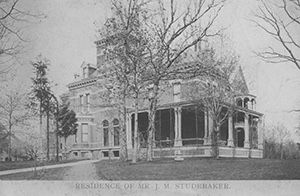
As the linked (above) article notes, the Sunnyside mansion was demolished in the 1950s, which facilitated the rapid development of what in South Bend are known as the Sunnyside and Sunnymede neighborhoods. Here, another map is useful: https://www.google.com/maps/d/u/0/viewer?mid=1DImy-dNaZPh34g1PpUMPbSjmoJ4&hl=en&ll=41.67579456945878%2C-86.22325266057722&z=14
Key searches on the map are “Coquillard Woods”, “Old Sunnyside Farm”, and “Sunnymede”. Our neighborhood, Coquillard Woods, is to the north and west of the other two, but quite close by. I amended my walk as I researched the development of the “Sunnyside” neighborhood that was developed after the “founding” Studebakers died early in the 20th Century. That estate is (or was) actually just a few blocks away from us, so I amended my walk to include the space, particularly after learning how the former estate was developed for single-family homes in the early 1900s. Nearer to our home on Madison Street (our house is on Madison and Esther) the homes first developed were small bungalows that are largely still standing.
Turning south on Jacob Street toward to posh Jefferson Boulevard, the houses become grander. Then today, a new house came on the market at the corner of Jefferson Blvd. and Jacob street. A little research illuminated some of the inequality of the burgeoning real estate boom of the 1920s. Who built this grand house right across Jefferson Boulevard from the former Sunnyside estate (or possibly part of it, it is unclear)? Former mayor of South Bend Fred. W. Keller. Why should we care? In 1892, Keller was the founding partner of realty developers Whitcomb & Keller—still in existence today—which innovated racially restrictive convenants in South Bend. And Keller is an interesting dude!
Fred Keller was born in rural northern Indiana in 1892 and went to college—at a time it was rare for people to go to high school—at what is now known as Valparaiso University. He went on to get a “special engineering degree” from the University of Michigan and became St. Joseph County surveyor, while building his real-estate company. He made a ton of money in the 1900s in real estate, as highlighted by one sale of a building for $20,000 in 1907, an equivalent of about $725,000 today. This was just one deal among thousands (South Bend Tribune).
Fred, known as “The Real Estate King” and his wife (only in his obit, not her own, noted as “Edith”, were frequent builders and movers. Before they moved into the house at Jacob and Jefferson in 1926, they had lived in at least four homes, according to the South Bend Tribune. But Fred was as interested in politics as he was in real estate. In 1912, he was one of a slate of electors for Teddy Roosevelt for the Republican convention. That slate was contested by another set of Republicans for Taft, notably one named Clement Studebaker, Jr—the guy who built the big estate at the corner of Jefferson and Esther. The competing slates of electors from Indiana were one of a bunch of electoral controversies in both the Democratic and Republican conventions in 1912. (Does this sound familiar?) Courts ultimately selected Fred W. Keller as one of two electors to the Republican National Convention, but Taft won both the nomination and the election.
Returning from this lost cause, Fred was a dedicated member of Roosevelt’s “Progressive Party” and then ran for mayor of South Bend, and won in 1913. At the time, he and Edith had been living for their longest stint in one home, 609 Portage Ave.
This might have been because this is when their three sons, born between 1899 and 1908, were growing up. (As a side note, all three sons spent their careers with Whitcomb & Keller.) Edith and Fred—now no longer mayor—celebrated Sunnymede racial restrictions as their home at Jefferson and Jacob streets was under construction in 1926, according to the South Bend Tribune.
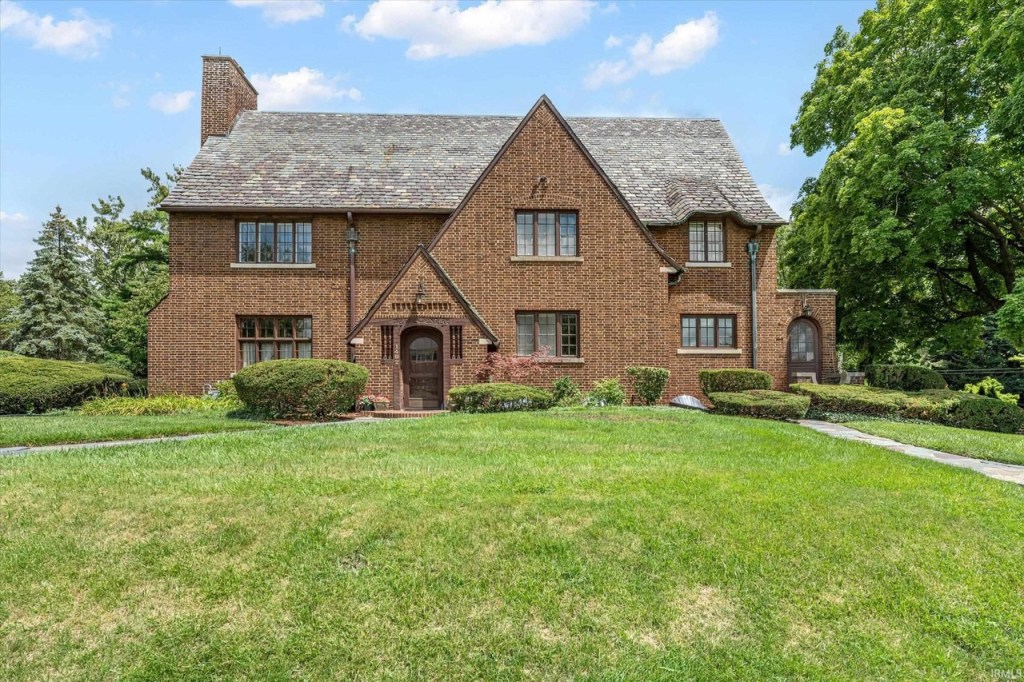
At least before 1944, when Edith died, they had moved to a house at the corner of Wayne St. and Greenlawn Ave., a home we walk, run, and bike by nearly daily. Again, this Sunnymede neighborhood was strictly racially restricted.
The links show that both the houses at Jefferson and Jacob and Wayne and Greenlawn have updated their kitchens (key hint, the ceiling lights). As we look forward to the completion of our kitchen renovation, I wonder how future owners will look upon the past that we know now.
 1936into2023
Leave a comment