Northern Indiana can be cold and it can be hot. When Glenn and Agda built their new house, good insulation would be important to these relatively older people building their dream house! One would want the best materials one could afford–and they did! The doors and trim they installed are cherry, a bit pricer then than pine or oak. They chose cedar siding, which was great for longevity and bug resistance. The roof material was also a tad more expensive, but super reliable, tremendously insulating, and, at the time, popular at the time: asbestos. What was unknown then was of the toxicity of asbestos.
We did not know that Glenn and Agda (or at least their builders) also chose asbestos insulation for the ceiling between the second floor and attic. Our workers, who are specialists in renovating older homes in South Bend, had almost completely demolished the original, second-floor bathroom and the closets nearby to turn the tiny space into something very useful.
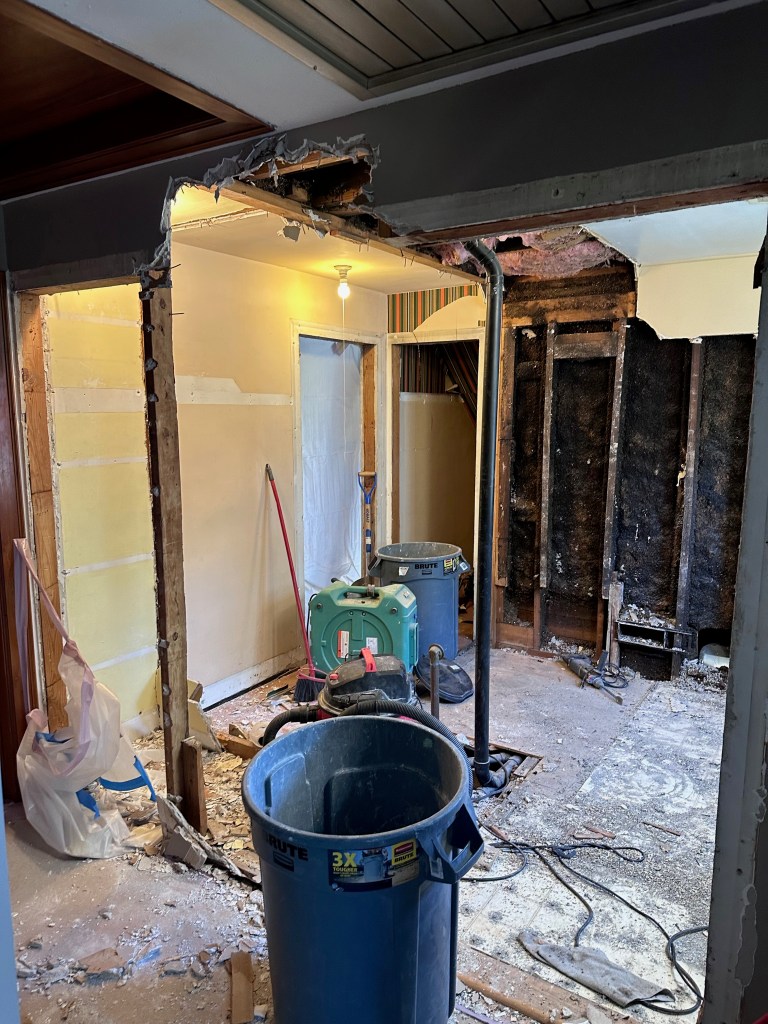
During the workers’ final push to demolish the space in preparation for building, they started to remove the ceiling insulation–and started to worry. They tested it and found it was asbestos. Again.
Perhaps that asbestos limited heat loss through the roof for nearly 90 years, but I doubt it. The bathroom was poorly insulated and commonly overly cold or hot. We had, in fact, considered installing heated floors–but abandoned that idea because we are not rich!
In fact, one reason for our major renovation was to solve poor insulation, plumbing, electrical, and more. We had no idea this toxic material was inside our house.
The workers, of course, stopped working when they tested the material. (As an aside, commercial asbestos testing is an expensive scam.) Our contractor offered to let us remove the material, but we are oldsters. Removing toxic material from the ceiling does not exactly fit into our skillsets, flexibility, or time availability. Tomorrow, we learn how toxic the cost of removing this material will be.
I learned of this as I was headed to classes to teach, which possibly enabled me not to obsess about what a money-pit we may have started. Hours later, I think: “what if we had just done a small-scale renovation?”
The answer is actually quite clear: even a basic renovation would have required exposing the same problem. We would have had to fix that–as well as other aged-house issues. That is the exact reason why we are doing the renovation.
Yet an important note for future old-house renovators: revelations like this are expensive and painful. Yet what you are doing is adding value to your home in the long run. (I mean long.)
[Focusing on the outcome!]
 1936into2023
Leave a comment