More than three weeks ago, the crews began demolition of our master bath. The 8’ by 8’ master bath. As in not huge. Why on earth would it take three weeks to demo a bathroom (and two small closets into which we were expanding)?
— At least four layers of walls over the original
— At least five layers of flooring
— Industrial-level spray-on asbestos!
One huge delay was asbestos removal. Houses built in the 1920s through 1970s were loaded with asbestos because it was thought to be a miracle insulator and fire proofing material. And it was! However, it is also deadly if inhaled—something early users did not know until workers started getting sick and dying.
Typically, most of that can be cleared away with normal demo (if carefully and well-masked). But the original owner/builder, Glenn Welch, was an exec at Studebaker. Glenn, apparently, thought that coating the entire frame of the ceilings with asbestos that was common only in factories, was a super great idea.
Thanks Glenn. I won’t even mention the cost to mitigate that with specialists, but that removal and cleaning sacrificed three days of actual demo until it was safe for the workers.
Because of the presence of asbestos, we don’t have a lot of photos to share because the spaces was tightly sealed off to keep us and everyone safe from inhaling the toxic stuff. But we do have some hints as to what the space looked like during different times.
It appears that the original bathroom in 1936 (and perhaps until the 1950s) had wallpaper with a cream base and multi-colored sprigs of flowers. We saw hints of this wallpaper when a regular wall cleaning knocked off jury-rigged trim that exposed the buried wallpaper. I did take a photo—months ago—but cannot find it!
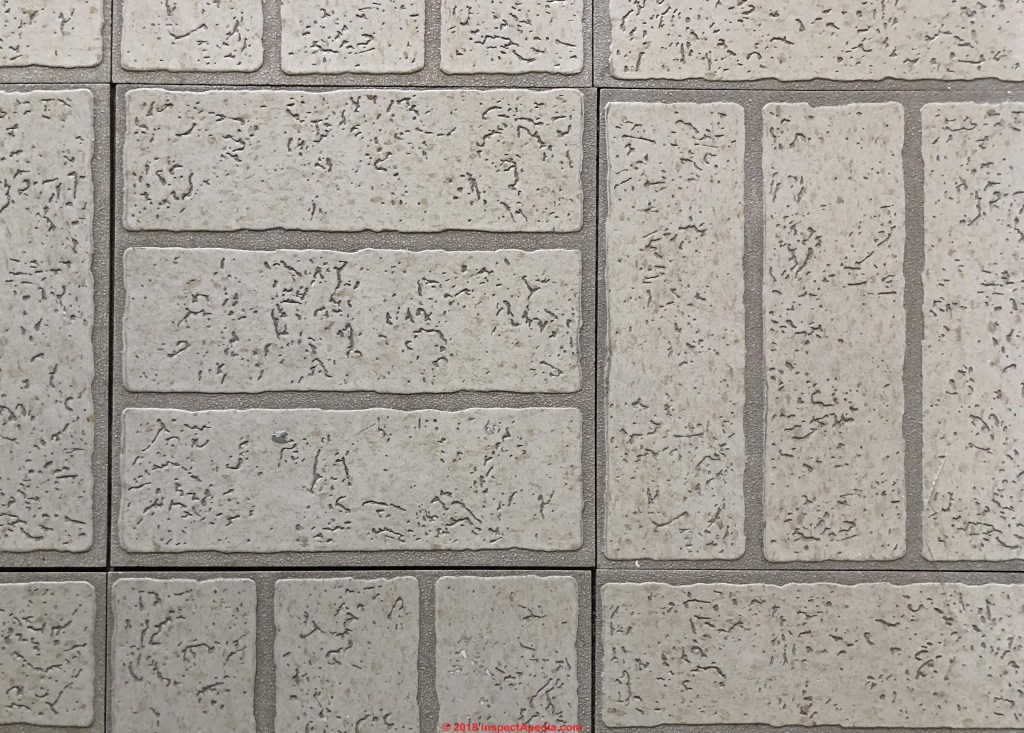
The floors were linoleum in a pattern of white brick, like this:
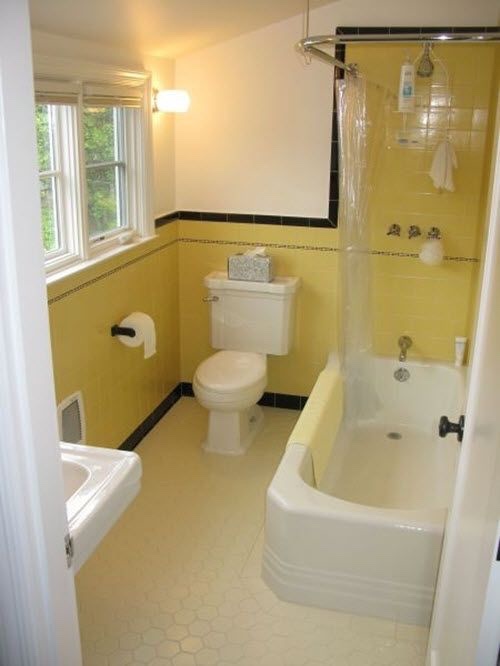
A newer layer was, again, linoleum. We didn’t see it, but our workers said it was in a different geometric pattern and installed in the 1950s. Possibly at the same time, homeowners installed yellow wall tile with black trim. It might have looked something like this:
We know from a previous homeowner (thanks!) that at least one major renovation happened in the 1970s. That family installed most of what the bathroom looked like until our renovation: chocolate brown tiled walls, black and white subway tile floor, a newer (shorter) bathtub, and a shower stall that replaced the bathroom closet. There may have been minor updates—perhaps a new stock vanity cabinet—in the intervening years.
But it is clear that ours is the first renovation that starts from scratch. We knew, of course, that this would be a major pain and expense, but we feel good about making sure we removed the covered-up DIY work—however well-intentioned—is something that we can enjoy for years and build a solid new foundation for new owners to make their own.
Today, demo is finally complete and the team is framing the new, expanded space. In the past few weeks and months (ugh) until it is complete, our bathing space (the link has photos) is our new shower on the main floor in the renovated space. Our older bladders have gotten used to the midnight treks from the guest room where we sleep (while the master suite is a wreck) down to the new main-floor toilet.
Our project manager has planned for the plumber to install all of the new plumbing from the basement to the master bath early next week. This will entail quite a bit of work, and is one of the major reasons we are doing the renovation: the plumbing sucked in every possible way and the walls were so poorly insulated (despite the asbestos fiends) that the wretched pipes were at risk of freezing and bursting most of every winter.
And honestly, we had no real idea just how bad our water pressure was until we updated the plumbing in the main floor of the house. Our shower now POURS with a low-flow shower head (as do all of our faucets now). We were annoyed with the lack of water pressure, but we got used to it more than we had realized.
We love living in a home rich with history and are thrilled to bring its potential into the current century and full use!
 1936into2023
Leave a comment